

Introduction: A New Era of Learning and Discovery
Imagine a classroom where students use artificial intelligence to solve real-world problems or a research lab where the Internet of Things (IoT) connects devices to create groundbreaking solutions. Sounds futuristic? It’s happening now, and companies like Bret Innovations are at the forefront of this transformation.
AI and IoT labs are revolutionizing education and research, creating spaces where innovation thrives. These labs are not just about technology—they’re about empowering students, researchers, and educators to think bigger, collaborate better, and solve problems faster. From personalized learning experiences to cutting-edge research, these labs are shaping the future of education and research in ways we couldn’t have imagined a decade ago.
In this blog, we’ll explore the transformative role of AI and IoT labs, practical steps to set them up, real-world success stories, and the challenges and opportunities they bring. Whether you’re an educator, researcher, or policymaker, this guide will show you why investing in AI and IoT labs is essential for staying ahead in today’s fast-evolving world.
The Role of AI and IoT Labs in Education
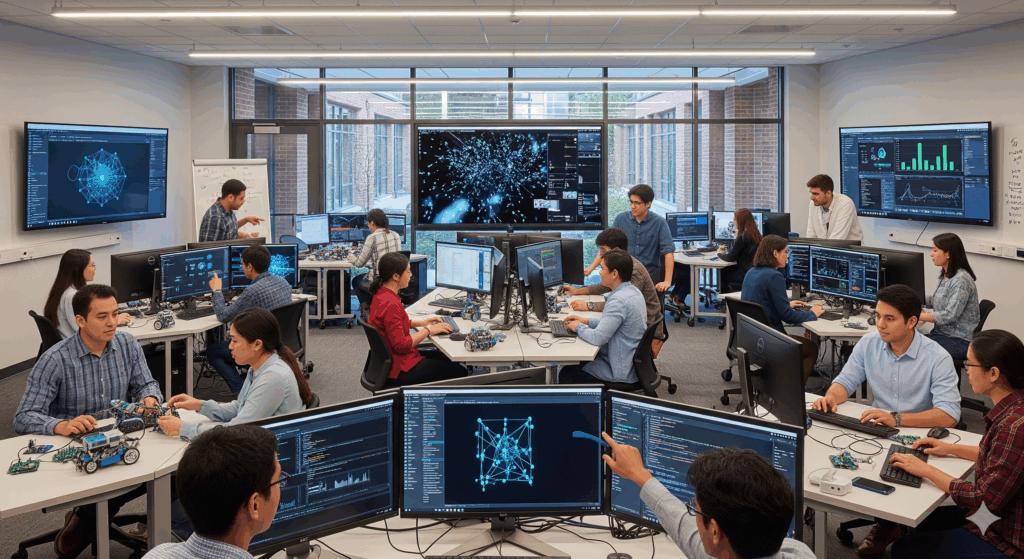
AI and IoT labs are transforming traditional education into a hands-on, tech-driven experience. They are no longer just spaces filled with computers and gadgets—they are hubs of creativity, innovation, and collaboration.
AI in Education Labs
Artificial Intelligence is making learning smarter, more personalized, and more effective. For example, AI in education labs focuses on adaptive learning, where AI tailors lessons to individual student needs. Imagine a system that identifies your weak areas and adjusts the curriculum to help you improve—this is the power of AI in education. AI can also automate repetitive tasks like grading, giving educators more time to focus on teaching and mentoring.
AI in education labs also enables students to work on real-world projects, such as developing chatbots, creating predictive models, or analyzing large datasets. These experiences not only enhance their technical skills but also prepare them for careers in AI-driven industries.
IoT Labs for Students
IoT labs give students the tools to experiment with connected devices and understand how they interact in real-world environments. These labs allow students to build projects like smart home systems, wearable health monitors, or even smart agriculture solutions.
IoT labs are not just for tech students—they’re for anyone who wants to innovate. For example, a biology student could use IoT sensors to monitor environmental changes, or an art student could create interactive installations using IoT devices. The possibilities are endless.
Practical Guide to Setting Up AI and IoT Labs
Setting up AI and IoT labs can seem daunting, but it doesn’t have to be. With the right approach, you can create a space that fosters innovation and collaboration. Here’s a step-by-step guide:
- Define Your Goals
The first step is to decide what you want to achieve with the lab. Will it focus on education, research, or both? For example, an AI lab might focus on machine learning projects, while an IoT lab could explore smart city solutions. Clearly defining your goals will help you choose the right tools and resources. - Choose the Right Tools
The tools you choose will depend on your goals. Here are some recommendations:- For AI labs: Invest in powerful computers, cloud platforms like AWS or Google Cloud, and software like TensorFlow or PyTorch.
- For IoT labs: Include sensors, microcontrollers (like Arduino or Raspberry Pi), and networking tools. You’ll also need software for data analysis and visualization.
- Start Small
You don’t need a massive budget to get started. Begin with a pilot project to test the setup and gather feedback. Use open-source tools to keep costs low. For example, you can use Google Colab for AI projects or Node-RED for IoT applications.
Collaborate
Partner with tech companies, other institutions, or government agencies to share resources and expertise. Collaboration can also help you secure funding and access the latest technologies.- Train Your Team
Ensure that educators, researchers, and students are trained to use the lab’s tools and technologies. Offer workshops, online courses, or certifications to build their skills. - Measure Impact
Regularly evaluate the lab’s impact on education and research. Are students learning new skills? Are researchers publishing more papers? Use these metrics to improve the lab and justify further investment.
Real-World Applications and Success Stories
Real-world success stories show the true potential of AI and IoT labs. Here are some inspiring examples:
AI-Powered Learning
AI-powered learning systems are transforming how students engage with education. These systems analyze data to understand how students learn best and adjust the curriculum accordingly. For example, if a student struggles with a particular concept, the system can provide additional resources or exercises to help them master it.
IoT in Action
IoT labs have enabled students to develop smart irrigation systems that use sensors to optimize water usage in agriculture. These projects not only save resources but also showcase the potential of IoT in solving global challenges. Another example is a student-led project that created a wearable device to monitor air quality, helping people with respiratory issues avoid polluted areas.
Interdisciplinary Collaboration
AI and IoT labs often bring together students and researchers from diverse fields. For example, an AI lab might collaborate with a medical school to develop predictive models for disease diagnosis, or an IoT lab might work with an environmental science department to monitor climate change.
Driving Research Through AI and IoT Labs
AI and IoT labs are not just for students—they’re hubs for groundbreaking research. Here’s how they’re driving innovation:
AI Experimentation Lab Setup
Researchers use AI labs to explore fields like natural language processing, predictive analytics, and robotics. For example, an AI lab might develop algorithms to analyze social media data for trends or create models to predict natural disasters. These labs are essential for pushing the boundaries of what AI can do.
IoT Research Labs
IoT labs focus on integrating devices and analyzing real-time data. For example, researchers might use IoT to monitor environmental changes, improve healthcare systems, or optimize supply chains. These labs often collaborate with industry partners to develop practical solutions to real-world problems.
Student-Centric Benefits and Engagement
AI and IoT labs are game-changers for students. Here’s why:
- Hands-On Learning
Students don’t just learn theory—they build projects, solve problems, and gain practical skills. For example, a student might use AI to analyze social media data or create an IoT device to monitor energy usage. - Career Readiness
These labs prepare students for high-demand careers in AI, IoT, and related fields. Employers value candidates with real-world experience, and these labs provide just that. - Creativity and Innovation
Students are encouraged to think outside the box, leading to innovative solutions and even startups. For example, a group of students might develop an AI-powered app to help people with disabilities or an IoT device to improve public safety.
Ethical Considerations and Challenges
While AI and IoT labs offer incredible opportunities, they also come with challenges. Here are some key considerations:
- Data Privacy
AI systems often require large datasets, raising concerns about how data is collected and used. Labs must prioritize ethical data practices and ensure compliance with regulations like GDPR. - AI Bias
If not carefully managed, AI systems can reflect biases in their training data. Researchers must work to ensure fairness and inclusivity in their algorithms. - Cost and Accessibility
Setting up these labs can be expensive, making them inaccessible to smaller institutions. To address this, institutions should explore partnerships, grants, and open-source tools.
Future Trends and Emerging Technologies

The future of AI and IoT labs is bright. Here’s what’s on the horizon:
- Edge Computing
IoT devices are becoming smarter, processing data locally instead of relying on cloud servers. This reduces latency and improves efficiency. - AI-Driven IoT
The integration of AI with IoT is creating smarter systems, from self-driving cars to intelligent healthcare devices. - Quantum Computing
While still in its early stages, quantum computing could revolutionize AI and IoT research, solving problems that are currently impossible.
Conclusion: The Time to Invest is Now
AI and IoT labs are not just a trend—they’re the future of education and research. They prepare students for the jobs of tomorrow, drive innovation, and solve real-world problems. Whether you’re an educator, researcher, or policymaker, investing in these labs is an investment in a brighter future.
Call to Action
Are you ready to transform your institution with AI and IoT labs? Start small, dream big, and watch innovation take flight