
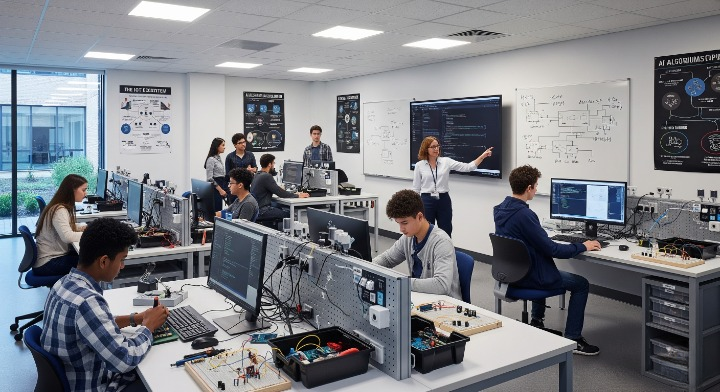
Defining IoT & AI Experimentation Labs
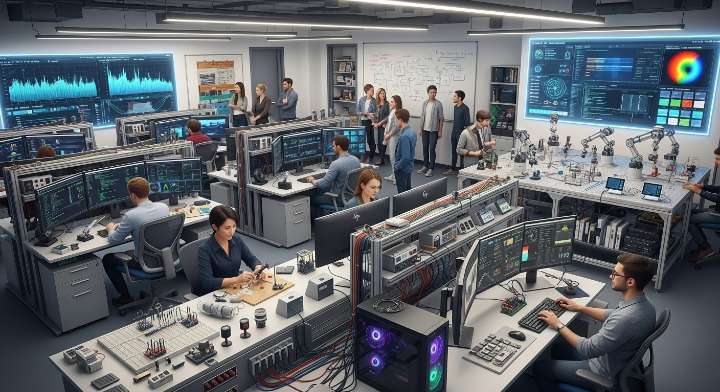
An IoT and AI experimentation lab is a specialized environment designed for the research, development, testing, and validation of Internet of Things (IoT) and Artificial Intelligence (AI) technologies. It’s a sandbox where researchers, engineers, and students can explore the intricate dance between connected devices and intelligent algorithms. Unlike a standard computer lab, this space integrates hardware, software, and networking components to simulate real-world scenarios.
The core purpose of these labs is to bridge the gap between theory and practice. They provide a controlled setting for hands-on learning and rapid prototyping, allowing innovators to fail fast, learn faster, and iterate toward success. From testing a new sensor’s accuracy to training a complex machine learning model, the IoT and AI lab setup provides the physical and digital infrastructure needed to push boundaries. These labs are catalysts for innovation, enabling the creation of smart lab solutions that can be scaled for commercial or societal impact.
Key Components of an Effective Lab Setup
A successful IoT and AI lab setup rests on three foundational pillars: infrastructure, equipment, and connectivity. Each component must be carefully planned to create a cohesive and functional ecosystem that can support a wide range of experiments.
Infrastructure: Scalable and Adaptable Spaces
The physical space is the backbone of your lab. It should be designed for flexibility. Research priorities shift, and technology evolves, so the lab’s layout must be easily reconfigurable. Consider modular furniture, mobile workstations, and ample power outlets. The design should also accommodate both collaborative zones for brainstorming and quiet areas for focused work. A well-planned AI research lab design ensures that the physical environment enhances, rather than hinders, productivity and creativity. This adaptability is key to a future-proof IoT and AI lab setup.
Equipment: Essential Tools and Devices
The heart of the lab is its equipment. This includes a wide array of hardware and software for both IoT and AI work. For IoT, this means sensors, actuators, microcontrollers, and single-board computers. For AI, the focus is on powerful computational resources, such as GPU-enabled servers. The selection of IoT experimentation equipment is a critical step that directly impacts the scope of possible projects. A robust IoT and AI lab setup requires a diverse and high-quality inventory of these tools.
Connectivity: Robust Network Infrastructure
IoT and AI are data-intensive fields. Billions of data points can be generated by IoT devices, and massive datasets are needed to train AI models. Consequently, a high-speed, reliable, and secure network is non-negotiable. This includes both wired Ethernet for stationary equipment and a powerful Wi-Fi network (including protocols like Wi-Fi 6) to support numerous wireless devices. A segmented network, which separates experimental device traffic from the main institutional network, is a crucial security measure in any IoT and AI lab setup.
Selecting Appropriate IoT Experimentation Equipment
Choosing the right IoT experimentation equipment is fundamental to a versatile and effective lab. Your choices will define the types of projects and research your lab can support. The goal is to balance capability, scalability, and budget. When planning your IoT and AI lab setup, focus on compatibility between components to ensure seamless integration.
Sensors, Actuators, and Microcontrollers
These are the building blocks of any IoT project. A good lab should have a diverse collection to allow for a wide range of applications.
| Category | Component Examples | Common Applications |
|---|---|---|
| Sensors | Temperature, humidity, motion (PIR), light (LDR), ultrasonic distance, gas sensors, accelerometers, gyroscopes | Environmental monitoring, security systems, robotics, wearable tech |
| Actuators | Servo motors, stepper motors, relays, LEDs, buzzers, LCD screens | Robotics, home automation, feedback systems, displays |
| Microcontrollers | Arduino (Uno, Nano, MKR family), ESP32, ESP8266 | Prototyping, data collection, controlling actuators, low-power applications |
| Single-Board Computers | Raspberry Pi (4, 5, Zero), NVIDIA Jetson Nano, BeagleBone Black | Edge computing, running lightweight AI models, managing multiple sensors, acting as a local gateway |
When selecting this IoT experimentation equipment, prioritize starter kits for beginners and individual components for advanced users. This tiered approach supports a broader range of skill levels. The scalability of your IoT and AI lab setup depends on choosing platforms with strong community support and extensive documentation, like Arduino and Raspberry Pi.
Designing an AI Research Lab
An effective AI research lab design goes beyond just allocating space; it’s about creating an environment optimized for the unique workflow of AI development. This involves careful consideration of layout, computational resources, and flexibility. The IoT and AI lab setup must facilitate the entire AI pipeline, from data ingestion to model deployment.
Layout Considerations for Optimal Workflow
The physical layout should support the distinct phases of AI research. Create dedicated zones for:
- Data Preparation and Annotation: Quiet workstations where researchers can clean and label large datasets.
- Model Training: A secure, well-ventilated area for housing GPU servers, which generate significant heat and noise.
- Collaboration and Ideation: Open spaces with whiteboards and presentation screens to foster teamwork.
- Hardware Integration: A workbench area, similar to an electronics lab, for integrating AI models with physical hardware like robots or IoT devices.
This zonal approach in your AI research lab design minimizes disruptions and creates a logical flow for projects. A thoughtfully organized IoT and AI lab setup enhances both efficiency and innovation.
Integration of Computational Resources and Storage
AI research, particularly in deep learning, is computationally expensive. Your IoT and AI lab setup must include robust computational resources. This means investing in servers with multiple high-end GPUs (Graphics Processing Units). Centralized servers are often more cost-effective and easier to manage than providing each researcher with a powerful desktop.
Equally important is a centralized data storage solution, such as a Network Attached Storage (NAS) system. This ensures that large datasets are accessible to all team members, simplifies data versioning, and facilitates backups. A combination of fast SSD storage for active datasets and larger, more affordable HDD storage for archival is a common and effective strategy.
Implementing Smart Lab Solutions
To maximize efficiency and truly embody the spirit of innovation, your IoT and AI lab setup should itself be a “smart” environment. Smart lab solutions involve leveraging automation, cloud platforms, and AI tools to streamline lab operations and enhance research capabilities.
Role of Automation in Enhancing Efficiency
Automation can be applied to various aspects of lab management.
- Environment Control: Use IoT sensors and actuators to automatically control lighting, temperature, and humidity, ensuring optimal conditions for both researchers and sensitive equipment.
- Equipment Monitoring: Implement systems to monitor the status and usage of high-demand equipment like 3D printers or GPU servers. This can include reservation systems and automated alerts for when a task is complete.
- Automated Testing: Develop scripts and frameworks to automate the testing of IoT devices and software, freeing up researchers’ time for more complex tasks.
These smart lab solutions not only improve efficiency but also serve as a real-world demonstration of the technologies being studied in the lab.
Use of Cloud Platforms for Data and Analysis
While local infrastructure is essential, cloud platforms (like AWS, Google Cloud, and Microsoft Azure) offer unparalleled scalability and a vast array of managed services. Integrating cloud platforms into your IoT and AI lab setup provides:
- Infinite Scalability: Train models on massive datasets using cloud-based GPU instances without investing in more physical hardware.
- Data Lakes: Store virtually unlimited amounts of raw data from IoT devices in a cost-effective and accessible manner.
- Managed AI/ML Services: Leverage pre-built services for image recognition, natural language processing, and other common AI tasks to accelerate prototyping.
A hybrid approach, combining on-premises hardware for day-to-day work and cloud resources for large-scale tasks, offers the best of both worlds for a modern IoT and AI lab setup.
Building a Robust Machine Learning Lab Infrastructure
A subset of AI, machine learning (ML), has specific infrastructure requirements that must be addressed in your lab design. A dedicated machine learning lab infrastructure is crucial for organizations that are serious about developing and deploying sophisticated models. This goes beyond a basic IoT and AI lab setup to focus specifically on the needs of data scientists and ML engineers.
Importance of GPU-Powered Systems
The training of deep learning models, a cornerstone of modern AI, is a process that involves millions of matrix calculations. GPUs are designed to perform these parallel computations far more efficiently than traditional CPUs. A machine learning lab infrastructure is incomplete without access to GPU-powered systems.
| GPU Tier | Use Case | Examples |
|---|---|---|
| Entry-Level | Student projects, learning, simple model training | NVIDIA GeForce RTX series (e.g., 4060, 4070) |
| Mid-Range | Advanced research, moderate model complexity, prototyping | NVIDIA RTX Ada Generation (e.g., RTX 4000) |
| High-End / Data Center | Large-scale model training, complex research, production workloads | NVIDIA H100, A100 |
For a versatile IoT and AI lab setup, a mix of entry-level and mid-range GPUs is often sufficient. Dedicated research centers will require high-end solutions.
Data Management Strategies
Effective data management is critical. A robust machine learning lab infrastructure must include:
- Data Version Control (DVC): Tools like DVC allow teams to track changes in datasets just like they track changes in code with Git.
- Data Pipelines: Automated workflows (ETL/ELT pipelines) to ingest, clean, transform, and prepare data for model training.
- Feature Stores: A centralized repository to store, share, and reuse features (data variables) across different models, ensuring consistency and saving time.
These strategies are essential for maintaining reproducibility and collaboration in machine learning projects, forming a key part of a professional IoT and AI lab setup.
Collaboration Tools
Machine learning is a team sport. Your infrastructure should support collaboration with tools like:
- JupyterHub/JupyterLab: Allows multiple users to run and share notebooks on a central server.
- MLflow/Weights & Biases: Platforms for tracking experiments, logging parameters, comparing results, and sharing models.
- Git-based Platforms (GitHub, GitLab): For version control of code and collaboration on development.
Integrating these tools into your machine learning lab infrastructure fosters a culture of transparency and shared knowledge.
Best Practices for Lab Maintenance and Support
Creating a state-of-the-art IoT and AI lab setup is only half the battle. Maintaining it is crucial for its long-term value and safety. A proactive approach to maintenance and support ensures that the lab remains a productive and reliable resource.
Regular Calibration and Testing of Equipment
IoT experimentation equipment, especially sensors, can drift over time, providing inaccurate readings.
- Schedule regular calibrations: Establish a schedule for checking sensors against known standards.
- Implement self-testing routines: For more complex setups, create scripts that run periodic health checks on devices and report anomalies.
- Keep a log: Maintain a detailed log of all maintenance activities, calibrations, and repairs for each piece of major equipment.
Software Updates and Security Protocols
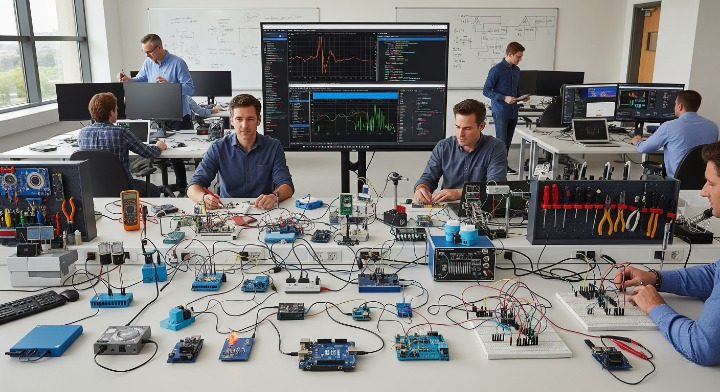
The software environment of an IoT and AI lab setup is complex and constantly evolving.
- Patch Management: Regularly update operating systems, software libraries (e.g., TensorFlow, PyTorch), and firmware to protect against vulnerabilities.
- Network Security: As mentioned, use a segmented network. Implement a firewall and monitor network traffic for suspicious activity.
- Access Control: Enforce strong password policies and use role-based access control to limit user permissions to only what is necessary.
A secure IoT and AI lab setup protects valuable intellectual property and prevents the lab from becoming a vector for cyberattacks.
Training Staff and Users
The most advanced lab is useless if no one knows how to operate it safely and effectively.
- Onboarding Program: Develop a mandatory onboarding program for all new users, covering safety procedures, equipment usage policies, and data management best practices.
- Ongoing Workshops: Host regular workshops on new equipment, software tools, and advanced techniques.
- Clear Documentation: Create and maintain a centralized wiki or knowledge base with user guides, tutorials, and FAQs for all lab resources.
Case Studies: Successful IoT and AI Lab Implementations
Examining real-world examples can provide valuable insights for planning your own IoT and AI lab setup.
MIT Media Lab: A world-renowned interdisciplinary research lab, the Media Lab is a prime example of a flexible and collaborative AI research lab design. Its open-plan architecture encourages cross-pollination of ideas between groups working on everything from wearable tech to tangible interfaces. Their success highlights the importance of breaking down silos and fostering a creative, hands-on culture.
Carnegie Mellon University’s IoT@CMU Lab: This lab focuses on developing and testing large-scale IoT systems. Their IoT and AI lab setup includes a building-scale testbed with thousands of sensors and devices. This case study demonstrates the value of creating a realistic, at-scale environment for testing the reliability, security, and performance of complex IoT deployments before real-world application. The infrastructure supports research on everything from smart building management to indoor localization.
Corporate Innovation Labs (e.g., Bosch, Siemens): Many large corporations have established their own IoT and AI labs to accelerate product development. These labs often have a highly focused machine learning lab infrastructure tailored to their specific industry, such as manufacturing or automotive. They serve as a bridge between pure research and product engineering, emphasizing rapid prototyping and integration with existing business units. Their success underscores the importance of aligning the lab’s mission with clear business objectives.
Conclusion
Building a cutting-edge IoT and AI experimentation lab is a strategic investment in the future. It’s about creating a dynamic ecosystem where ideas can flourish and innovation can be systematically pursued. From the foundational decision of an adaptable AI research lab design to the granular details of selecting IoT experimentation equipment, every choice matters. A successful IoT and AI lab setup requires a holistic approach that integrates flexible infrastructure, powerful equipment, robust connectivity, and smart operational solutions.
By establishing a strong machine learning lab infrastructure, implementing rigorous maintenance practices, and fostering a culture of collaboration and learning, institutions can create an environment that attracts top talent and produces groundbreaking results. The journey to create the perfect IoT and AI lab setup is complex, but the reward is a powerful engine for research and innovation that will drive progress for years to come. The time to invest in these transformative spaces is now.